

One soldier does not make a battlefield. Even the Bank of Japan's fivefold interest rate hike under Kazuo Ueda to 1%—the highest in 31 years—has not helped the yen find solid ground. USD/JPY is moving toward 40-year highs, and hedge funds are positioned against the "yen" as aggressively as they have been since 2007. According to the Commodity Futures Trading Commission, bets on further declines of the yen rose to nearly 138,000 contracts by the end of June.
Dynamics of Speculative Positions on the Yen
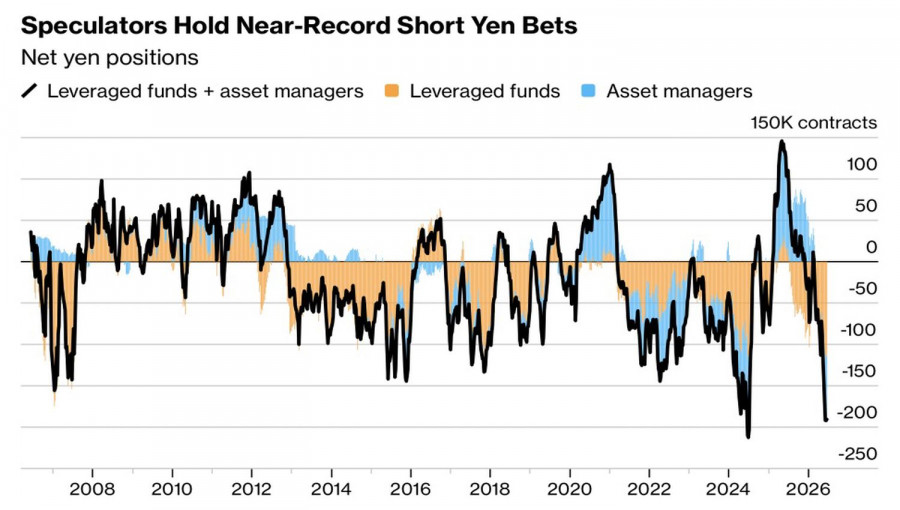
At first glance, it seems paradoxical, as Japan's economy appears strong. Bank lending in June grew at record rates since the pandemic, and the Tankan survey indicated the first improvement in business financial conditions in a year. However, Edmond de Rothschild Asset Management believes the current weakness of the yen is excessive and does not reflect the strong fundamentals of the Japanese economy.
The issue lies in the interest rate differential. Goldman Sachs has revised its forecast for USD/JPY from 155 to 165 over the year, making it one of the most "bearish" banks on Wall Street. The reason is the persistent yield gap between US and Japanese bonds, fiscal pressure on Tokyo, and the gradual nature of the Bank of Japan's monetary tightening. Most surveyed economists expect one more rate increase to 1.75% by the end of the cycle. US interest rate markets assess the chances of the pair rising to 165 by next summer at 76%.
Additional pressure is created by political uncertainty. Markets are speculating whether the administration of Sanae Takaichi is trying to delay the BoJ's rate hikes to finance fiscal expansion. Minister Minoru Kiuchi denies this, calling media reports inaccurate. However, the appointment of new members to the Board of Directors who are sympathetic to soft policy raises doubts.
Dynamics of USD/JPY and Currency Interventions
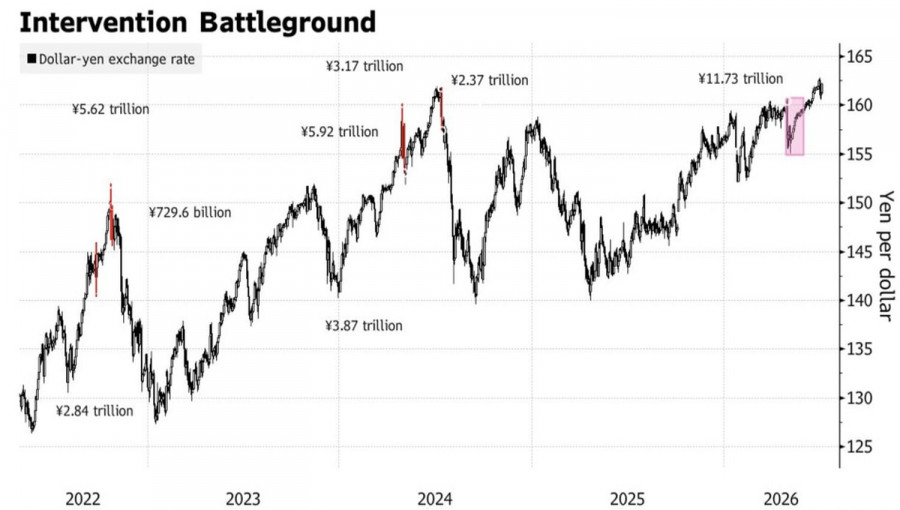
According to Edmond de Rothschild, currency interventions are inevitable. The company predicts coordinated intervention from the BoJ, the Federal Reserve, and the European Central Bank in the second half of the year. If it occurs, the US dollar could retreat to £155, and the current peak just below £163 risks becoming the peak of the upward trend. Without interventions, any strengthening of the yen, the company warns, will merely be a short episode rather than a reversal of the trend.
Thus, the fundamentals favor the yen, while market sentiment and speculators' positioning are against it. Only coordinated actions by central banks can resolve this dispute, recalling the Plaza Accord agreement of 1985. Will we see interventions before the US dollar reaches £170?
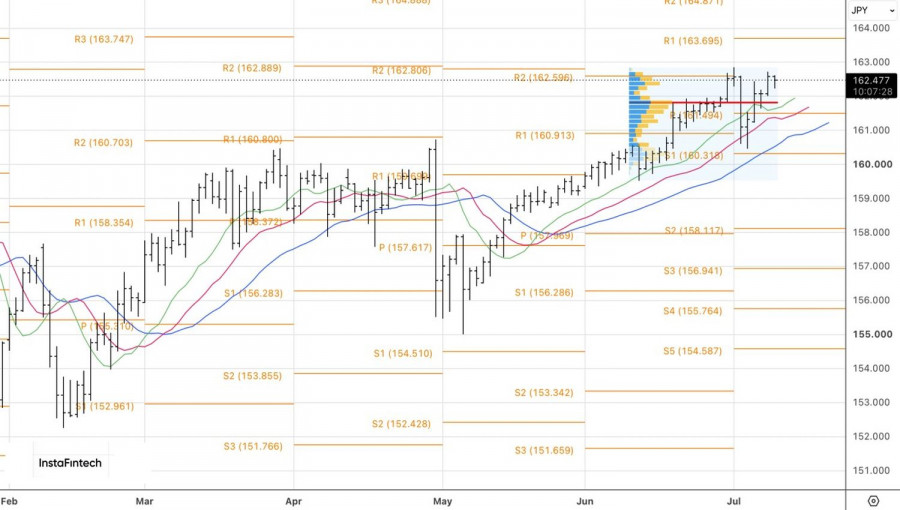
Technically, on the daily chart, USD/JPY is forming an inside bar near a double top. If these reversal patterns play out, the risks of a corrective movement to the upward trend will increase. A breakout below the support level at £162.25 will provide a basis for forming short positions in the US dollar.
The material has been provided by InstaForex Company - www.instaforex.comfrom Forex analysis review https://ift.tt/lahyxck
via IFTTT