

Last week's GDP report showed the economy grew 0.2% in Q2 after a revised 0.9% rise in Q1. This is the fourth consecutive quarter of growth and materially beats the Reserve Bank of New Zealand's zero forecast used in its May policy statement. Annual growth reached 2.6%.
Housing construction led the expansion after last year's recession; public administration, manufacturing and wholesale trade also made positive contributions.
On the downside, GDP per capita rose only 0.1%, and household disposable income fell 0.4%. Households are cutting trips and eating out to make ends meet, and fuel purchases fell to levels not seen since COVID lockdowns.
Westpac's consumer-confidence index rose to 89.5 in Q3 from a three-year low of 80.4 the quarter before. Formally, this is an improvement, but any value below 100 remains deeply negative.
For the RBNZ, this signal is ambiguous. Weak consumption helps contain inflationary pressure, but if households are already stretched, further tightening risks turning a slow recovery into a new recession.
GDP stronger than the RBNZ's forecast gives hawks an argument for a third consecutive rate hike in October. However, weak consumer sentiment and falling real incomes point the other way.
The RBNZ's September inflation-expectations survey shows one-year expectations at 2.6% and two-year expectations at 2.34% — moderate readings. If next month's data do not surprise on the upside, the RBNZ will probably prefer to pause in October to assess the effects of two hikes and revisit policy in November or December.
The situation in the Persian Gulf remains the main external risk for New Zealand's economy. Market participants at the APPEC conference in Singapore described near-absurd precautions: tankers transiting with AIS turned off, ship names blacked out, crews sheltered in protected areas on the less vulnerable side. For New Zealand, this means a perpetual risk of new fuel-price spikes. VLCC freight rates from the Gulf to East Asia hit a record $161.93/ton, so the threat of a large-scale energy shock remains high.
Positioning: Kiwi is in a net long position of about +$0.57bn; the implied fair price remains above the long-term average.
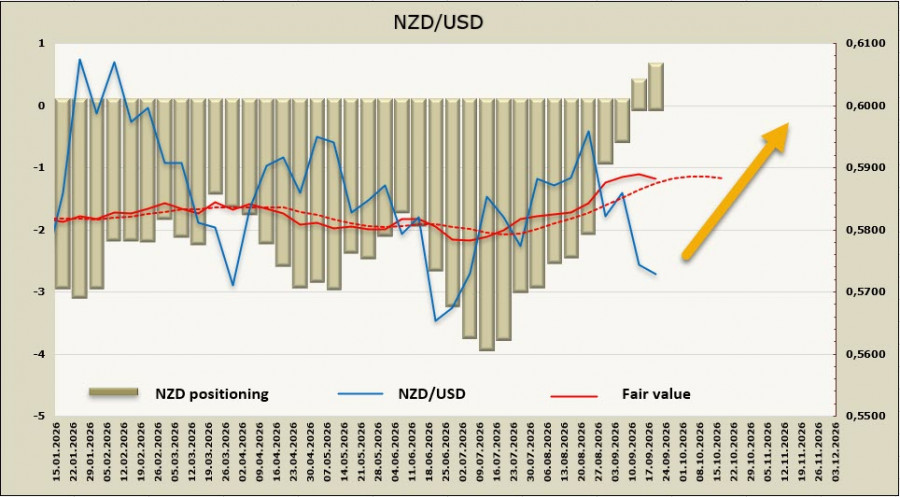
Technically, NZD/USD has held above the trendline at 0.5640–0.5650, which remains key support. The bearish impulse looks close to exhaustion, and a renewed attempt to rally is expected. A target area would be roughly 0.5820–0.5840, but there is not yet enough evidence for a confident trend reversal. The most likely scenario is range trading with a slow upward bias.
The material has been provided by InstaForex Company - www.instaforex.comfrom Forex analysis review https://ift.tt/nk0l1yo
via IFTTT