

If it weren't for the conflict in the Middle East, the global economy would be entering a period of rapid growth thanks to investments in artificial intelligence, reduced tariff burdens, and large-scale fiscal and monetary stimuli. The OECD was set to raise its global GDP forecast for 2026 from 2.6% to 2.9%. However, instead, it maintained its previous forecast and significantly raised inflation estimates.
The US dollar is the currency of pessimists, while the euro represents optimists. Thus, the grim news from the Paris-based organization became one of the factors contributing to the decline of EUR/USD. Additionally, the OECD raised its inflation forecast for America by 1.2 percentage points, while for Europe it was raised by only 0.7 percentage points. In theory, this means that the Fed must be more aggressive than the ECB in battling high prices.
OECD Inflation Forecasts
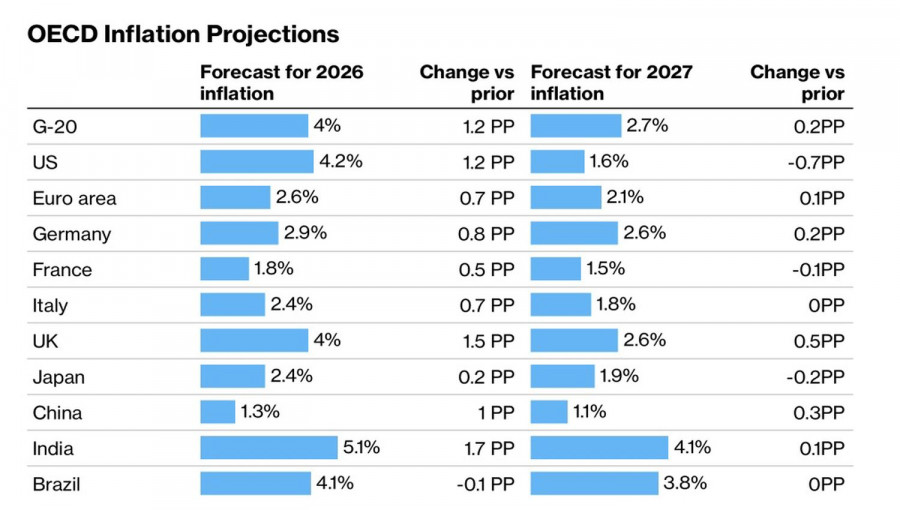
This implies that market expectations that the Federal Reserve will prolong the pause in monetary easing until the end of the year, while the European Central Bank will implement 2-3 acts of monetary restriction, are incorrect. Investors should reassess these expectations. The American dollar stands to gain from this.
Support for the dollar continues to come from geopolitical factors and oil prices. Donald Trump stated that it is time for Iran to take things seriously. If it doesn't, there will be no going back. It's time to negotiate. Otherwise, the White House threatens to wipe the country off the map. Increased bombings and even a ground landing are expected. Meanwhile, Israel continues to eliminate key figures of the opposition, including those responsible for blocking the Strait of Hormuz.
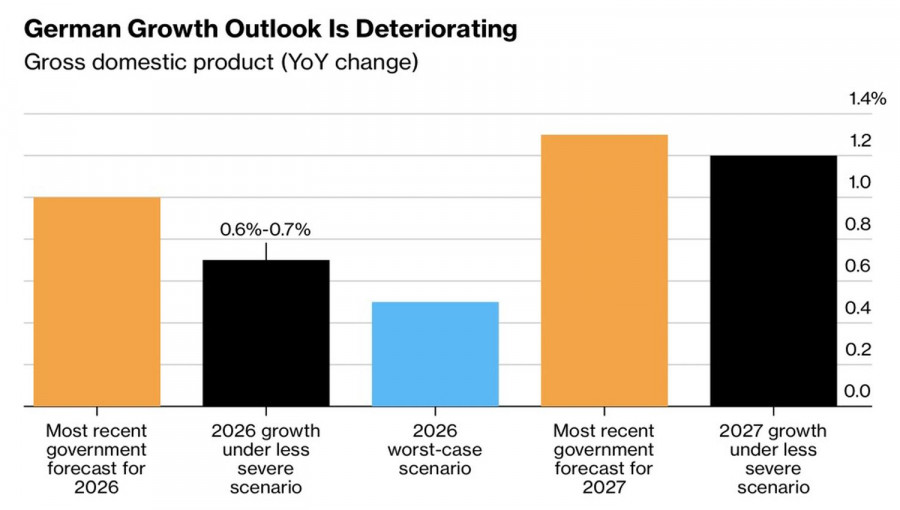
The longer the conflict in the Middle East persists, the more the German economy will suffer. The government has downgraded its 2026 GDP growth forecast from 1% to 0.5%, assuming hostilities will continue for an extended period and oil prices will rise further. If Brent stabilizes at current levels, GDP may expand by 0.6-0.7%.
Germany's Economic Forecasts
In this situation, calls from ECB President Christine Lagarde and Bundesbank President Joachim Nagel for rate hikes appear dangerous. Can the eurozone economy withstand higher borrowing costs? I doubt it.
Markets are clearly underestimating the likelihood of a Federal Reserve tightening of monetary policy. If inflation increases by 1.2 percentage points from the current 2.5-2.7%, the central bank will need to raise alarms, forget about Trump's calls, and tighten monetary policy. The US dollar, already a safe-haven asset, will gain a new advantage. As a result, the decline of the main currency pair will resume with renewed vigor.
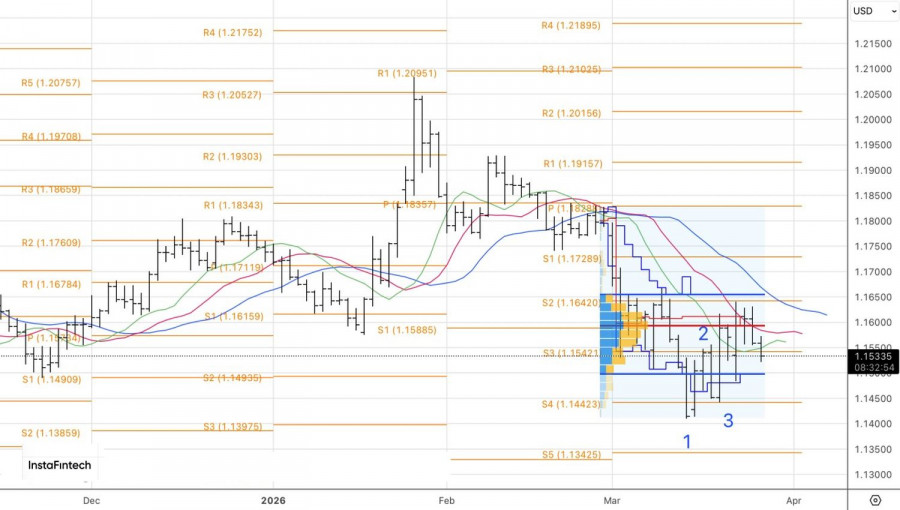
Technically, on the daily chart of EUR/USD, the bulls' inability to hold prices above the fair value at 1.1590 is a sign of their weakness. A consolidation below the pivot level of 1.1540 will increase the risks of continuation of the decline toward 1.1495 and 1.1440. In this situation, it makes sense to stick to the previous selling strategy.
The material has been provided by InstaForex Company - www.instaforex.comfrom Forex analysis review https://ift.tt/qDeOXxc
via IFTTT